
Confused by Etsy fees? Read our beginner’s guide to easily understand listing costs, transaction fees, and payment processing rates to maximize your profits.
One of the first things new sellers ask before opening an Etsy shop is:
“How much does Etsy charge?”
This is an important question because many beginners focus on sales but forget to calculate fees.
Understanding Etsy fees helps you:
- price products correctly
- avoid surprises
- protect your profit margins
- build a sustainable Etsy business
The good news is that Etsy’s fee structure is relatively straightforward once you understand the basics.
In this guide, I’ll explain the main Etsy fees beginners should know about and how they affect your profits.
What Etsy Fees Are
When you sell on Etsy, the platform charges various fees for using its marketplace.
These fees help cover:
- marketplace operations
- payment processing
- buyer traffic
- platform maintenance
- marketing services
Think of Etsy fees as the cost of accessing millions of buyers who are already searching for products.
Understanding these costs is essential before launching your shop.
1. Etsy Listing Fee
The Etsy listing fee is the first fee most beginners encounter.
An Etsy listing fee is $0.20 USD per item.
You are charged this flat fee when you create or renew a product listing on the platform, regardless of whether the item eventually sells.
Key Rules of Etsy Listing Fees:
| Expiration | Every listing lasts for exactly four months before it expires. |
| Renewals | Keeping an unsold item active after four months costs another $0.20 USD. |
| Multi-Quantity Items | If you list 10 identical items, you pay $0.20 USD upfront. Once the first item sells, the listing automatically renews and charges you $0.20 USD for the next available unit. |
| Editing | Changing text, photos, or tags on an active listing is completely free. |
| Setup Fee | Depending on your region, new shops may also encounter a one-time onboarding setup fee ranging from $15 to $29 USD, which often includes your first 20 listings. |
The fee is charged when the listing goes live.
Why Etsy Charges a Listing Fee
The listing fee helps Etsy maintain its marketplace and encourages sellers to create intentional listings rather than flooding the platform with low-quality products.
For beginners, listing fees are usually one of the smallest Etsy expenses.
Beginner Tip
When you’re starting out, focus on creating quality listings instead of uploading hundreds of products immediately.
A smaller number of well-optimized listings is usually better than a large number of rushed listings.
2. Etsy Transaction Fee
Whenever you make a sale, Etsy charges a transaction fee.
This fee is calculated as a percentage of the sale amount.
The transaction fee applies to:
- product price
- certain additional charges associated with the order
The Etsy transaction fee is 6.5% of the total amount your customer pays.
This fee is calculated on the entire order value, meaning it applies to the item price, shipping costs, and any additional gift-wrapping or personalization fees you charge.
Important Details About the Transaction Fee:
| How it is billed | On your Etsy statement, this fee is usually split into two separate line items: one for the transaction fee on the product itself, and one for the transaction fee on the shipping cost. |
| Sales Tax exclusion (US) | If you sell from the United States, the 6.5% transaction fee does not apply to the sales tax collected at checkout. |
| Sales Tax inclusion (International) | If you sell from outside the US, the fee is applied to your listed price, which by local laws must already include any applicable taxes. |
| Timing | This fee is taken automatically from your shop’s payment balance the exact moment a sale is made. |
Quick Mathematical Example
If you sell a handmade ceramic mug for $20 and charge $5 for shipping, the math works out like this:
Total Order Value = $20+$5 = $25

Transaction Fee = $25×6.5% = $1.63
(Note: Don’t forget that a separate payment processing fee, usually 3% + $0.25 in the US, will also be deducted from the total transaction).
This fee is one reason why pricing products correctly is important.
3. Etsy Payment Processing Fee
When a buyer pays through Etsy Payments, payment processing fees apply.
These fees help cover:
- credit card processing
- payment security
- transaction handling
Payment processing fees vary by country.
In the United States, the Etsy payment processing fee is 3% + $0.25 USD per transaction.
Unlike the transaction fee, the payment processing fee is calculated on the gross order total, which includes the item price, shipping fees, and any sales tax paid by the buyer.
Fee Rates by Region
Etsy Payments rates vary depending on the country where your bank account is located. Below is a breakdown of common regional processing fees according to the official Etsy Help Center.
| Country | Fees |
|---|---|
| United States | 3% + $0.25 USD |
| United Kingdom | 4% + £0.20 GBP |
| Canada | 3% + $0.25 CAD (Internal domestic sales) |
| Australia | 3% + $0.25 AUD (Internal domestic sales) |
| European Union | Typically 4% + €0.30 EUR (Varies slightly by specific nation) |
| India | 3% to 5% + ₹25 INR |
Real-World Example (US Seller):
If a buyer purchases an item from your shop with the following breakdown:
- Item Price: $20.00
- Shipping: $5.00
- Sales Tax: $2.00
- Total Paid by Buyer: $27.00
The processing fee is calculated on the full $27.00:
Processing Fee = ($27.00×0.03)+$0.25 = $1.06Difference Between the Two Main Fees:
Many new sellers get confused because Etsy charges two separate percentages on every sale. They serve entirely different purposes:
| Transaction Fee (6.5%) | Payment Processing Fee (3% + $0.25) |
| This is Etsy’s commission for hosting the marketplace and matching you with a buyer. It applies only to the item + shipping (excluding US sales tax). | This pays for the secure credit card processing infrastructure (handling Visa, Mastercard, Apple Pay, etc.). It applies to the absolute total amount processed. |
4. Offsite Ads Fee
One Etsy fee that surprises many beginners is the Offsite Ads fee.
Offsite Ads allow Etsy to advertise listings on external platforms such as:
- search engines
- social media platforms
- partner websites
If:
- A buyer clicks one of these ads
- Then purchases your product within the attribution window
Etsy Offsite Ad fees are either 12% or 15% of the total order value, depending entirely on your shop’s trailing 12-month sales volume.
You are only charged this fee if a buyer clicks an external ad (on Google, Facebook, Instagram, Pinterest, or Bing) and purchases from your shop within 30 days of that click. If a buyer clicks an ad but does not buy anything, you pay nothing.
A. Fee Breakdown Based on Shop Revenue
According to the official Etsy Fees & Payments Policy, your rate is calculated on the first day of each month based on your prior 365 days of sales.
| Under $10,000 USD in annual sales: | You are charged a 15% fee on attributed orders. At this level, participation is optional, and you can opt out at any time via your shop dashboard. |
| $10,000 USD or more in annual sales: | You receive a discounted 12% fee. However, participation becomes permanently mandatory for the lifetime of your shop, even if your future revenue drops below the threshold. |
B. Critical Rules of Offsite Ads
| Fee Cap: | The maximum Offsite Ad fee for any single order is capped at $100 USD, regardless of how expensive the item is. |
| The “30-Day Window”: | If a buyer clicks your ad, they can buy multiple items or return multiple times within 30 days, and every single order they place during that window will incur the ad fee. |
| What it applies to: | Just like transaction fees, the 12% or 15% is taken from the total order cost (item price + shipping + any gift wrapping). |
C. The True Cost: A Compounded Fee Example
Offsite ad fees do not replace standard selling fees; they are added on top of them. If you are a US-based seller at the 15% ad tier making a sale on a $30.00 total order, the compounded fees look like this:
==================================================
        OFFSITE ADS COMPOUNDED FEE EXAMPLE
==================================================

Total Order Value:            $30.00
--------------------------------------------------
Standard Transaction Fee (6.5%): $1.95
Payment Processing Fee (3%+$0.25):$1.15
Offsite Ads Fee (15%):           $4.50
Fixed Listing Fee:               $0.20
--------------------------------------------------
Total Etsy Fees for this sale:   $7.80  (26% of order)

Your Net Payout:              $22.20
==================================================
D. How Offsite Ads Can Help
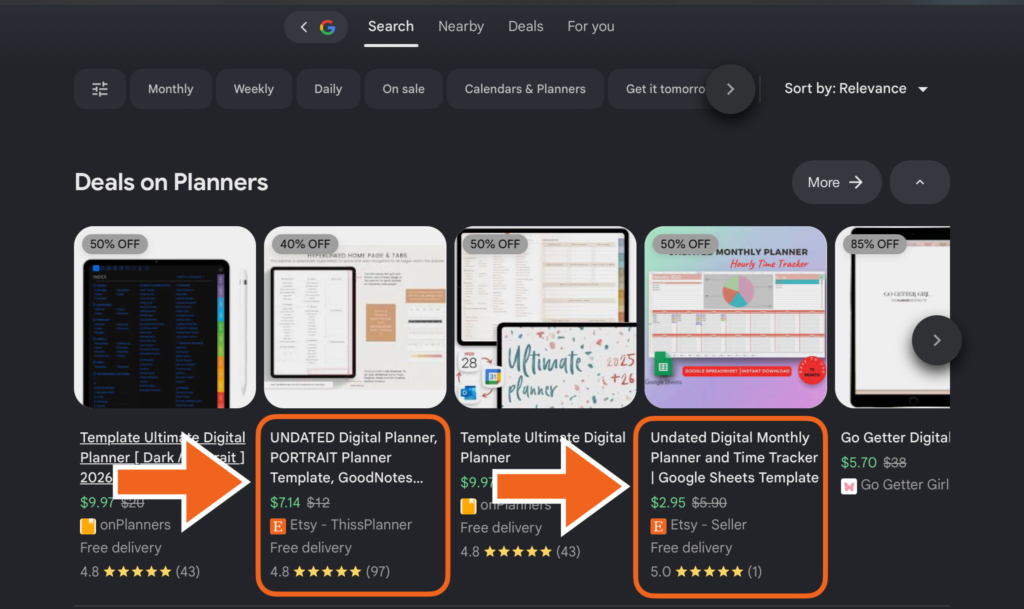
Many beginners see this fee and immediately dislike it.
However, Offsite Ads can also generate sales that sellers might never have received otherwise.
For some shops, these ads become an important source of traffic.
Common Fee Mistakes Beginners Make
Many new sellers make similar mistakes.
1. Ignoring Fees Completely
Some beginners price products without calculating fees.
This can lead to very small profit margins.
2. Copying Competitor Prices
A competitor’s pricing may work because:
- they have different costs
- they use different suppliers
- they operate at higher volume
Always calculate your own numbers.
3. Underpricing Products
Many beginners price products too low because they fear competition.
This often creates profit problems later.
4. Forgetting Advertising Costs
If you use:
- Etsy Ads
- Offsite Ads
- social media advertising
those costs should be considered when evaluating profitability.
5. Focusing Only on Revenue
Revenue and profit are not the same thing.
A shop generating sales is not necessarily profitable.
Remember:
Some beginners obsess over Etsy fees while ignoring the value Etsy provides.
Without Etsy, many new sellers would need to spend far more money attracting buyers independently.
Are Etsy Fees Worth It?
For many beginners, yes.
Why?
Because Etsy provides:
- marketplace traffic
- buyer trust
- payment infrastructure
- search functionality
- ecommerce tools
Building all of this independently would often cost much more.
This is one reason many sellers choose Etsy instead of launching a standalone store immediately.
If you’re comparing platforms, you may also enjoy:
- “Etsy vs Shopify for Beginners”
- “Is Selling on Etsy Worth It in 2026?”
- “Can You Start an Etsy Shop With No Money?”
These guides help explain the bigger picture of Etsy costs and opportunities.
Tips to Manage Etsy Costs
You cannot eliminate Etsy fees, but you can manage them wisely.
1. Price Products Correctly
Always calculate fees before setting prices.
2. Improve Etsy SEO
Better SEO can increase organic traffic.
Helpful resources:
3. Create Higher-Value Products
Higher-priced products often provide more room for profit after fees.
4. Track Profit Margins
Monitor:
- sales
- fees
- advertising costs
- product expenses
This helps you understand actual profitability.
5. Focus on Quality
Strong products often perform better than large quantities of weak listings.
Digital Products and Etsy Fees
Many beginners choose digital products because they eliminate costs such as:
- inventory
- shipping
- packaging
Examples include:
- printables
- planners
- templates
- wall art
Although Etsy fees still apply, digital products can often have higher profit margins due to lower operating costs.
Should Fees Stop You From Starting Etsy?
In most cases, no.
Every business has costs.
The goal is not avoiding fees entirely.
The goal is creating products that remain profitable after fees are deducted.
Many successful Etsy sellers started with:
- small budgets
- simple products
- basic designs
and improved over time.
Understanding fees simply helps you make smarter business decisions.
Final Thoughts
Etsy fees are a normal part of selling on the platform.
As a beginner, you should understand:
- listing fees
- transaction fees
- payment processing fees
- Offsite Ads fees
before pricing products.
The most important lesson is:
Profit matters more than revenue.
A product that sells frequently but generates little profit may not be a good business.
Take time to calculate costs, price products carefully, and focus on long-term sustainability.
Many successful Etsy sellers treat fees as a normal cost of accessing a marketplace filled with active buyers.
FAQs About Etsy Fees
What fees does Etsy charge sellers?
The main Etsy fees include:
- listing fees
- transaction fees
- payment processing fees
- Offsite Ads fees (when applicable)
Does Etsy charge a fee to list products?
Yes. Etsy charges $0.20 USD per item when a product listing is published.
Does Etsy take a percentage of every sale?
Yes. Etsy charges 6.5% of the total amount your customer pays on qualifying sales.
Do all sales include an Offsite Ads fee?
No. Offsite Ads fees only apply when an eligible sale comes from an Etsy Offsite Ad click.
Are Etsy fees worth paying?
For many sellers, yes. Etsy provides marketplace traffic, buyer trust, payment systems, and ecommerce infrastructure that would be expensive to build independently.