

Finding the right keywords is one of the most important parts of Etsy SEO. Etsy keyword research helps you discover the words and phrases shoppers use when searching for products like yours, so you can use relevant keywords in your listings.
For beginners, the challenge isn’t simply finding popular Etsy keywords. You need to find keywords that are relevant to your product, match shopper intent, and give your listing a realistic opportunity to be discovered.
What is Etsy keyword research?
Etsy keyword research is the process of finding and evaluating the words and phrases shoppers use to search for products on Etsy. The goal is to identify relevant keywords you can use in your listing titles, tags, descriptions, and other parts of your shop to help Etsy understand what you’re selling.
In this guide, you’ll learn how to do keyword research for Etsy step by step, how to find Etsy keyword ideas, how to choose the best keywords, and how to use them in your Etsy listings.
Even if you’re not sure why keyword research is important or how to do it, this guide will walk you through everything you need to know.
Today, I’m excited to help you explore:
- What is Etsy Keyword research?
- What is the importance of Etsy Keyword research?
- How Etsy Keyword research could benefit you?
- How to perform Etsy Keyword research?
Let’s start with the basics…
1. What is Keyword Research?
Keyword research is the process of finding keywords that would drive targeted traffic to your business. Mostly, this is done by identifying how your target buyers are finding a products like yours.
Let me simplify it,
when we are looking for a product, we search on Etsy home page. We expect the Etsy search engine to give us a product within the first page of search. Keyword research helps us to identify those “phrases”, “words”, “queries”, that the mass is asking using an Etsy search bar.
As an Etsy Shop owner, when we know what kind of queries buyers (users) are asking via search bar on Etsy, we can optimize, helping users to find the products, and use that traffic to grow our business.
In technical words;
The purpose of Keyword research is to find those “topics”, and “product ideas” and assign a business value to them, which is commonly used by your target buyers. Another way to look at Keyword research is: It helps you to discover those questions and queries that your target customers are asking on the web, and gives you the advantage to speak the language your customer will understand.
Let us understand this with an example:
A simple example is, let’s say a recently became father wants to buy a stroller for his kid. He uses this query “Best baby stroller” in Etsy search, to find the best brand. Something like this…
(You could be anyone, and replace the baby stroller with your product)
Since Etsy search is smart, it auto-populates a lot of frequently used queries to help the father ask the right question.
Now, depending on the father’s location, and his understanding, he will stick with his query, or perhaps pick one that is suggested by Etsy.
Now, the Etsy keeps a log of how many times these queries are being asked by millions of users around the globe.
The process of keyword research shows the most popular query, along with geo-location, and the number of times these queries have been asked within a specific time (ex: 30 days).
Now, as an Etsy shop owner, these stats would help you understand which of these queries, you should answer on Etsy Search Bar, and in turn, it will help buyers to discover your Etsy Shop and the products.
The solution ultimately helps Etsy Shop owners to drive more targeted traffic from search engines, which converts into direct sales, ad sales.
Well, this is how SEO keyword research helps.
With a little preparation, you could drive significant traffic to your shop and hence make most out of your hard work.
By using keyword research tools, we could find data like which keyword “Also known as queries, question, the search term” a parent is using on Etsy to find a product.
The following result is from a tool called “eRank”, which shows similar queries with a lot of data as shown below:
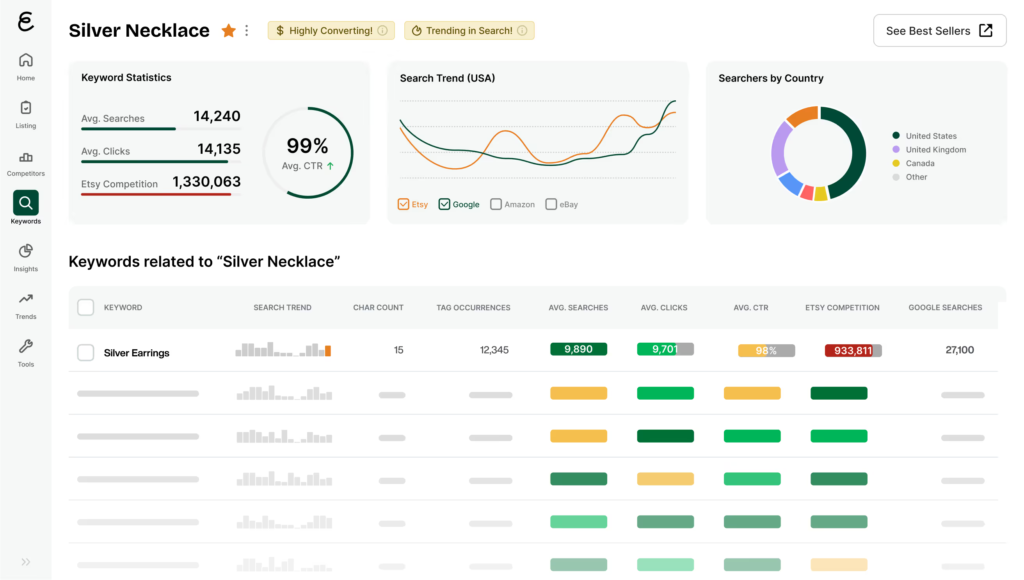
Let’s try to understand what’s happening in this image. (Even if you don’t understand 100%, don’t worry as this is normal for a beginner.)
- Search Trend: A 15-month historical graph showing the monthly search volume for a keyword. It helps you identify seasonality (e.g., when Christmas searches peak) and whether a term is rising or falling in popularity.
- Avg. Searches: The average number of times Etsy shoppers search for that exact keyword each month, typically based on the last 12 months of data.
- Avg. Clicks: The average monthly number of clicks that listings receive when they appear in search results for that keyword.
- Avg. CTR (Click-Through Rate): The ratio of average clicks to average searches, expressed as a percentage. A high CTR suggests that the listings appearing for that search are highly relevant and appealing to shoppers.
- Note: A CTR over 100% means shoppers are clicking on more than one listing per search.
Listing and Competition Metrics
- Char Count: Short for Character Count. This specifically refers to the number of characters in a tag or title. Etsy has a 20-character limit for each of your 13 tags, and eRank uses this to help you stay within those limits.
- Tag Occurrences: Used primarily in competitor analysis, this shows how many times a specific tag appears across a shop’s most recent active listings (usually the last 100). It helps you identify which tags your competitors rely on most.
- Etsy Competition: The total number of active listings on Etsy that are currently using that keyword. High competition (often shown in red) means many sellers are fighting for that term, while low competition (green) indicates a possible niche opportunity.
- Google Searches: The estimated monthly search volume for that keyword on Google, rather than just within Etsy. This helps you understand a term’s broader popularity on the wider web.
To find high-potential keywords, look for those with high average searches and high CTR, but low Etsy competition.
Like this, there are many matrices you will be getting when you start Etsy Keyword research.
In a nutshell, Etsy Keyword research helps you to make data-driven decisions. In case you are not aware, data is the new oil.
A Simple Etsy Keyword Checklist
Before using an Etsy keyword, ask:
- Is it relevant to my exact product?
- Would a potential customer actually use this phrase?
- Does it clearly describe what I’m selling?
- Is the search intent a good match for my product?
- Can I naturally use this keyword in my listing?
You don’t need to find one “perfect” Etsy keyword. The goal is to build a group of relevant keyword phrases that describe your product from different angles while still matching what shoppers are looking for. Start with the most relevant phrases and expand your list with closely related variations.
Now, let’s explore the advantages of keyword research.
2. Why Keyword Research for Etsy SEO Matters
Not all keywords are equal, and let’s try to quantify this. The process of Keyword research could help your Etsy Shop in the following ways:
- Keyword research helps you understand the language used by your target customers on Etsy.
- It helps you discover untapped queries, that could directly help you get paid customers from organic searches such as Google search, Baidu, and others.
- Engaged buyer: The buyer that you will be receiving is already hot (ready to buy), and you will get high engagement in the form of comments, sharing, or even a sale.
- Market and customer trend: Periodically, performing Keyword research will help you to understand in which direction the market and customers are heading.
- Competitive advantage: Incorporating keywords and SEO before your competitors, will give you a solid advantage. If done right, in a less crowded niche, it could help you earn a sale as a first-mover advantage.
- Reduce Advertisement Cost: Keywords SEO will help you drive those customers for free, which a shop owner, usually pays for in the form of Ad Cost. Such organic ranking could significantly reduce your Etsy Shop’s digital marketing cost.
Here is a less known fact about Keyword research:
A lot of people mistake keyword research as the process of finding only high-volume keywords, which is not the fact.
Your task as an SEO professional is to remove those keywords which are not going to benefit your business in any way. Moreover, after finding profitable keywords, you will also learn how do you prioritize them for maximum benefits in a shorter span.
3. Types of Keywords based on a number of words:
- Short tail Keywords a.k.a Head Keywords: (Ex: Baby stroller)
- Long-tail keywords. (Ex: Best baby stroller in Australia)

A. How to Choose the Best Etsy Keywords
The best Etsy keywords aren’t necessarily the ones with the highest search volume. A useful keyword should be closely related to your product, match what a shopper would actually search for, and give you a realistic opportunity to reach the right audience.
When comparing Etsy keyword ideas, consider three things: relevance, buyer intent, and competition. A highly relevant keyword that matches the product exactly can be more valuable than a broad keyword with more searches but much stronger competition.
For example, instead of targeting a broad phrase like “planner,” a beginner selling a printable weekly planner might consider more specific phrases such as “printable weekly planner” or “weekly planner PDF.” The exact keywords you choose should always reflect the product you’re actually selling.
B. Quick Comparison
| Etsy Category | Short-Tail Keyword (Generic) | Long-Tail Keyword (Specific / Buying Intent) |
|---|---|---|
| Jewelry | silver ring | chunky sterling silver statement ring for women |
| Jewelry | pearl necklace | dainty freshwater pearl choker bridal necklace |
| Home Decor | scented candle | hand poured soy wax lavender vanilla candle |
| Home Decor | throw pillow | boho tufted lumbar pillow cover 12×20 |
| Weddings | bridal veil | cathedral length soft tulle lace applique veil |
| Weddings | wedding gift | personalized cutting board wedding gift for couple |
| Clothing | baby onesie | organic cotton gender neutral newborn romper |
| Clothing | graphic tee | vintage 90s aesthetic oversized graphic t-shirt |
| Digital Goods | planner | undated digital planner goodnotes hyperlinked |
| Digital Goods | logo design | minimalist beauty salon premade logo branding kit |
| Craft Supplies | stickers | waterproof vinyl laptop stickers for tech geeks |
| Craft Supplies | fabric | floral print linen cotton blend apparel fabric |
| Gifts | pet portrait | custom royal pet portrait oil painting canvas |
| Gifts | keychain | engraved leather initials keychain for boyfriend |
Now, I believe you and I are on the same page, and it’s time to learn how to do Etsy keyword research.
4. How to perform Keyword research?
The goal of Etsy keyword research isn’t to find the most popular keyword possible. It’s to find relevant search phrases that match your product and what Etsy shoppers are looking for. A good Etsy keyword should describe your product accurately, match shopper intent, and be realistic for your listing to compete for.
Here’s a simple Etsy keyword research process you can follow:
Step 1: Identify Your Seed Keywords
To get more people to see your Etsy shop, start by making a list of words that truly describe what you sell. These “core keywords” are the secret to helping shoppers find your items.
Don’t just use generic words; think about what makes your products special. Focus on details like your materials, how they are made, or unique features. For example, if you sell notebooks, use specific phrases like “eco-friendly paper,” “hand-sewn,” or “personalized.”
Try to think like your customers—what exact words would they type into the search bar to find you? Once you have this basic list, you’ll have a great foundation to grow your shop’s reach.
Step 2: Use Etsy Search Suggestions
You can also use Etsy’s search bar to find even better keywords. Start typing your main idea, and watch the suggestions that pop up—these are the actual phrases shoppers are using right now.
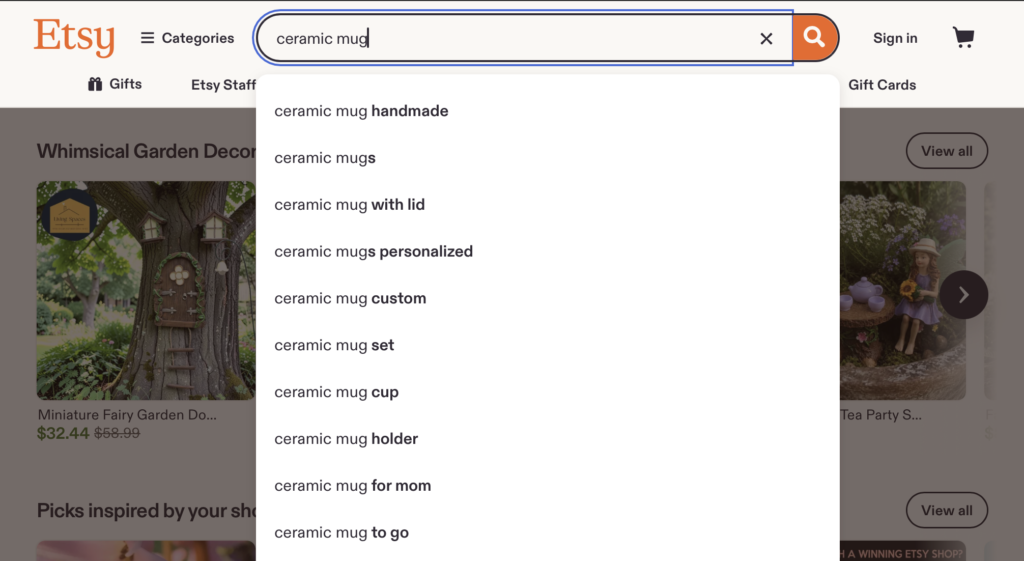
Pay close attention to the longer, more specific phrases (called “long-tail keywords”). Instead of just “ceramic mug,” you might see “handmade ceramic tea mug.” These specific terms usually have less competition and help you reach buyers who are ready to buy exactly what you’re making.
Adding these phrases to your titles and tags makes it much easier for the right customers to find your shop.
Tip: Start with a broad product phrase and look at the specific suggestions Etsy provides. These suggestions can help you discover more specific keyword ideas and understand how shoppers may describe products like yours. Don’t copy every suggestion automatically—only use phrases that accurately describe your product.
Turn One Etsy Keyword Into Multiple Ideas
Once you find one useful keyword, use it as a starting point rather than stopping there. Look for closely related phrases that describe the same product from a slightly different angle. For example, a seller offering a printable budget planner might explore variations such as “printable budget planner,” “budget planner PDF,” “monthly budget printable,”and “digital budget planner.” Only keep variations that genuinely match the product.
Suggested Read: How to Write Etsy Titles That Get Clicks
Step 3: Try Keyword Research Tools
To take things to the next level, use keyword research tools to see exactly what’s working. These tools show you how popular a word is and how hard it will be to rank for it, helping you pick the best terms to bring more traffic to your shop.
Look for tools that track new trends and show you what your competitors are doing. Often, the best strategy is to find a “sweet spot”—a keyword that plenty of people search for but isn’t already crowded with other sellers. If you do go after a high-competition word, you’ll know you need to step up your photos and descriptions to stand out.
By regularly checking these tools and updating your keywords, you’ll stay ahead of the game and keep your shop relevant as trends change.
Step 4: Analyze Competitor Listings
Take a look at successful shops in your niche to see which keywords they use to get noticed. By checking out their top listings, you can learn which phrases are actually attracting buyers and how they are used.
Pay attention to where they put their keywords in titles, tags, and descriptions. The best sellers find a balance: they use enough keywords for Etsy’s search engine to find them, but keep the writing natural and helpful for shoppers.
Look for common words or patterns that keep showing up in these top listings—these are usually the “winning” terms. Use these insights as inspiration to improve your own shop while keeping your unique brand style.
Step 5: Implement Keywords Strategically
To boost your shop’s visibility, place your keywords where they matter most: your titles, tags, and descriptions. Put your most important words at the very beginning of your titles so both shoppers and Etsy’s search engine see them first.
Make sure to use all 13 tags. Mix broad terms with more specific phrases to cover all the different ways someone might search for your item.
In your descriptions, don’t just list keywords—weave them naturally into the story of your product. Describe the craftsmanship and materials in a way that feels helpful and friendly to the reader. This makes your listing easy to find and much more interesting to buy.
Where to Use Your Etsy Keywords
Once you’ve selected your keywords, use them naturally throughout your Etsy listing. Your most important phrases can help describe your product in the title, while other relevant variations can be incorporated into your tags and description where they make sense.
Avoid repeating the same keyword unnecessarily or adding phrases that don’t accurately describe your product. Your goal is to make your listing clear to both Etsy’s search system and the shoppers who see it.
Example: If you’re selling a printable weekly planner, your keyword research might identify phrases such as “printable weekly planner,” “weekly planner PDF,” and “digital weekly planner.” You can use relevant phrases where they naturally fit rather than forcing every variation into the title.
If you’re ready to optimize the rest of your Etsy listing, see our guide on How to Write Etsy Product Descriptions That Sell for practical tips on turning your keyword research into clearer, more persuasive listing copy.
Step 6: Monitor Performance and Adjust
To keep your shop successful, check your Etsy stats regularly to see which keywords are actually bringing people in. You might be surprised to find that some words work better than you expected, while others aren’t doing much at all.
Use this info to update your strategy: if a word is working well, use it on more of your items. If one isn’t performing, swap it out for something new that fits current trends.
Remember, it’s not just about words—also take a look at your photos, prices, and reviews. Keeping everything updated based on what the data shows will help your shop stay competitive and attractive to buyers.
Common Etsy Keyword Research Mistakes
1. Choosing keywords that don’t accurately describe the product
A keyword may have attractive search potential, but if it doesn’t match the product, it isn’t useful.
2. Targeting only broad keywords
Broad phrases can be difficult to compete for. More specific, relevant phrases can help you reach shoppers with clearer intent.
3. Using the same keyword everywhere
Your listing should read naturally. Don’t repeat a phrase unnecessarily just because you want to target it.
4. Ignoring keyword variations
Different shoppers may describe the same type of product in different ways. Related, accurate phrases can expand your opportunities for discovery.
5. Never reviewing your keywords
Search behavior and competition can change. Review your keyword performance periodically and update your strategy when you have enough data.
The goal isn’t to stuff your Etsy listing with keywords. It’s to understand what shoppers are searching for and use relevant phrases naturally throughout your listing.
Want a step-by-step Etsy roadmap? Keyword research is only one part of building a successful Etsy shop. If you’re a beginner and want a clear path from choosing your product idea to preparing your shop and working toward your first sale, the Etsy Beginner Launch Kit gives you eight practical milestones to follow.
FAQs about Keyword Research in Etsy SEO
1. What exactly is Etsy keyword research?
It is the process of finding the specific words and phrases shoppers type into the Etsy search bar to find products. By knowing these terms, you can use them in your own listings so that your shop appears when customers are looking for items like yours.
2. Why is keyword research important for my shop?
It helps you “speak the language” of your customers. Instead of guessing, you use data to find terms that are popular but have low competition. This makes it easier for you to stand out, get more visitors for free, and reduce the money you spend on ads.
3. Where is the best place to start my keyword research?
Start with “Seed Keywords.” These are basic words that describe your product’s materials, features, or unique traits (like “eco-friendly paper” or “hand-sewn”). Once you have these, you can type them into the Etsy search bar to see what “search suggestions” pop up to find even more ideas.
4. What is the difference between “Short-tail” and “Long-tail” keywords?
Short-tail keywords are broad, 1–2 word phrases (like “baby stroller”) that have high competition. Long-tail keywords are longer, more specific phrases (like “best baby stroller in Australia”). Long-tail keywords are usually better for smaller shops because they attract shoppers who are ready to buy exactly what you have.
5. Why should I look at my competitors’ listings?
By studying successful shops in your niche, you can see which keywords they use in their titles and tags to stay visible. This isn’t about copying them, but rather finding “winning” patterns and common phrases that are already proven to attract buyers in your market.
6. How often should I change or update my keywords?
You should regularly check your Etsy stats to see which words are bringing in traffic. If a keyword is performing well, keep it or use it on more items. If it’s not working after a few weeks, swap it out for a new trend or a different specific phrase to keep your shop competitive.
7. How do tools like eRank help with my SEO?
These tools provide “data-driven” insights, such as how many people search for a word each month and how many other sellers are using that same word. This helps you avoid crowded markets and find “niche opportunities” where it is easier to make a sale.
8. Is keyword research only about finding the most popular words?
No. While high volume is good, the goal is to find profitable keywords. This means removing words that don’t fit your business and prioritizing specific phrases that bring in “ready-to-buy” customers who are more likely to make a purchase.