
Learn Etsy customer service basics for beginners, including buyer messages, negative reviews, returns, refunds, cases, and professional communication.
Running an Etsy shop isn’t only about creating products and getting sales. Once buyers start finding your listings, you’ll also need to answer questions, handle order issues, respond to reviews, and communicate professionally with customers.
Good customer service can help you build trust and create a better buying experience. It can also help you avoid unnecessary disputes and misunderstandings.
If you’re new to Etsy, you don’t need to be an expert at customer service. You simply need a simple system for responding to buyers, handling common problems, and knowing when to use Etsy’s support and case processes.
In this guide, you’ll learn how Etsy customer service works, how to respond to common buyer messages, how to handle reviews and difficult situations, and what beginners should know about returns and refunds.
Quick Answer: Etsy customer service is the process of communicating with buyers and handling questions, orders, reviews, returns, refunds, and other customer issues professionally. As a beginner, focus on responding promptly, communicating clearly, keeping your promises, and following your shop policies and Etsy’s current requirements.
What Is Etsy Customer Service?
Etsy customer service is everything you do to communicate with buyers and help them have a smooth experience before, during, and after an order.
For a seller, this can include:
- Answering questions about your products
- Explaining processing and shipping times
- Responding to customization requests
- Helping buyers with order-related questions
- Handling cancellations, returns, refunds, or exchanges according to your policies
- Responding professionally to reviews
- Resolving problems when an order doesn’t go as expected
Good customer service doesn’t mean saying yes to every buyer request. It means communicating clearly, setting realistic expectations, and following your shop policies and Etsy’s rules.
For new sellers, having a simple customer-service system can make running your shop much easier. Instead of worrying about what to say every time a buyer sends a message, you can prepare responses for common situations and handle each conversation calmly and professionally.
f you’re still setting up your shop, make sure you’ve covered the basics in our Etsy beginner guide before focusing on customer service.
Why Does Customer Service Matter on Etsy?
Customer service matters because buyers are more likely to trust a shop when the seller communicates clearly and handles problems professionally.
Etsy also has customer service standards for sellers that include factors such as message response rate, on-time shipping and tracking, average review rating, and case rate. Meeting Etsy’s standards can help sellers maintain a good customer experience and avoid potential impacts on their shop.
How to Respond to Etsy Messages
When you start getting messages from Etsy buyers, try to respond clearly, politely, and as soon as reasonably possible.
You don’t need to write long replies. A helpful message usually answers the buyer’s question, gives them the information they need, and sets a clear expectation about what happens next.
1. Respond Promptly
Try not to leave buyer messages unanswered for days.
Etsy’s customer service standards include a message response requirement. Etsy currently measures whether sellers respond to at least 80% of first messages within 48 hours.
Etsy also provides guidance on communicating with buyers, including keeping messages clear, concise, professional, and empathetic.
You don’t have to be online all day. Instead, create a simple habit of checking your Etsy messages regularly.
2. Keep Your Tone Friendly and Professional
Even when a buyer asks a question you’ve answered many times, respond politely.
Instead of:
“It’s already written in the listing.”
Try:
“Hi! Thanks for reaching out. Yes, this item is available, and the current processing time is listed on the product page. I’d be happy to help if you have any other questions.”
A friendly response can make the buying experience feel much more personal.
3. Answer the Actual Question
Read the buyer’s message carefully before replying.
If they ask about:
- Size → give the relevant measurements.
- Processing time → explain when the order will be prepared.
- Customization → tell them what you can and cannot change.
- Digital files → explain what they’ll receive and how delivery works.
- Shipping → provide the information available in your listing or order details.
Avoid sending a generic reply that doesn’t answer what the buyer actually asked.
Clear product information can prevent many questions before they happen. See our guide on how to write Etsy product descriptions that sell for tips on making your listings easier for buyers to understand.
4. Don’t Promise What You Can’t Guarantee
Be realistic about processing times, shipping, customization, and delivery.
For example, if your normal processing time is 3–5 business days, don’t promise that an order will definitely arrive tomorrow simply because a buyer asks.
Clear expectations can prevent misunderstandings later.
5. Keep Important Conversations on Etsy
When discussing an Etsy order or buyer request, keep relevant communication within Etsy Messages whenever possible.
This gives you a clear record of what was discussed and helps you manage the order if a problem occurs later.
A Simple Rule for Etsy Messages
Before sending a reply, ask yourself:
Did I answer the buyer’s question clearly, give accurate information, and explain what happens next?
If the answer is yes, your message is probably on the right track.
Common Etsy Buyer Messages & How to Reply
Buyers often ask similar questions before and after placing an order. Having a simple way to respond can save you time and help you communicate more professionally.
Below are some common situations Etsy beginners may encounter.
“Is this item available?”
Keep the answer short and friendly.
Example:
Hi! Thanks for reaching out. Yes, this item is currently available. Please let me know if you’d like any additional information before placing your order.
“Can you customize this?”
Don’t promise customization unless you’re actually able to provide it.
Example:
Hi! Thanks for asking. Yes, I can customize [specific part of the product]. Please send me the details you’d like changed, and I’ll let you know what’s possible.
If you don’t offer customization:
Hi! Thanks for reaching out. At the moment, this item is only available in the options shown in the listing. I appreciate your interest!
If you’re still preparing your first listing, our guide on how to create your first Etsy listing can help you work through the setup step by step.
“Can you ship this sooner?”
Be honest about your processing time.
Example:
Hi! Thanks for your message. My current processing time is [X] business days. I’ll do my best to prepare the order as quickly as possible, but I don’t want to promise a delivery date I can’t guarantee.
“Can I get a discount?”
You don’t have to say yes.
If you want to offer a discount:
Thanks for your interest! I can offer you [X]% off this order. You can use the discount code [CODE] at checkout.
If you don’t:
Thanks so much for your interest! The current price is the best price I’m offering at the moment, but I really appreciate you checking out my shop.
“Where is my order?”
First, check the order status and available tracking information before replying.
Example:
Hi! Thanks for reaching out. I checked your order, and the current status shows [STATUS]. You can also view the tracking information from your Etsy order details. Please let me know if you have any other questions.
Don’t guess where an order is if you don’t have reliable information.
“Can I change my order?”
Check whether the requested change is possible before confirming anything.
Example:
Hi! Thanks for reaching out. I’ll check whether I can make that change before the order is processed. I’ll get back to you as soon as I confirm the details.
“Can I cancel my order?”
Don’t automatically promise a cancellation. First check your shop policies, the order status, and whether the order has already entered processing or shipping.
Example:
Hi! Thanks for reaching out. I’ll check the current status of your order and whether cancellation is possible at this stage. I’ll update you shortly.
A Simple Customer-Service Formula
When you’re unsure what to say, use this simple structure:
Acknowledge → Answer → Explain → Next Step
For example:
“Thanks for reaching out. Yes, customization is available. I can change the text and color, but the design itself can’t be modified. Please send me the text you’d like to use, and I’ll confirm the details.”
This keeps your responses clear without making them unnecessarily long.
How to Handle Difficult Etsy Customers
Not every Etsy customer interaction will be easy.
A buyer may be unhappy with an order, misunderstand your listing, ask for something you don’t offer, or become frustrated because of a delay.
The best approach is to stay calm, professional, and focused on solving the actual problem.
1. Don’t Respond Emotionally
If a buyer sends an angry message, avoid replying immediately while you’re frustrated.
Read the message carefully, check the order details, and then respond to the specific issue.
Your goal isn’t to win an argument. Your goal is to handle the situation professionally.
2. Check the Facts Before Replying
Before responding, check:
- The original order
- Your listing description
- Your shop policies
- Processing and shipping information
- Any previous messages with the buyer
- Tracking information, if applicable
This helps you avoid making assumptions.
Having clear shop policies makes these situations much easier to handle. If you haven’t created yours yet, see our guide on how to write Etsy shop policies for beginners.
3. Acknowledge the Buyer’s Concern
You don’t have to admit fault simply because a buyer is unhappy.
You can acknowledge the problem without immediately accepting responsibility.
For example:
“Hi! I’m sorry to hear that you’re having trouble with your order. I’ve checked the order details and would like to understand what happened so I can help.”
This keeps the conversation calm and moves it toward a solution.
4. Explain What You Can Do
Once you’ve checked the situation, clearly explain the next step.
For example:
“I’ve checked your order, and it was shipped on [DATE]. The tracking information currently shows [STATUS]. You can use the tracking link in your order details to see the latest update.”
Or, if there is an issue with the product:
“Thanks for letting me know. Please send me a photo of the issue so I can review it and determine the best next step.”
Don’t offer a solution you aren’t actually able to provide.
5. Know When to Stop Going Back and Forth
Some conversations don’t get better by sending more and more messages.
If you cannot resolve an issue directly, use Etsy’s available support and case processes where appropriate.
Keep your communication factual and professional throughout the process.
6. Never Threaten or Pressure a Buyer
Avoid statements such as:
- “Give me a five-star review or I’ll…”
- “Cancel your complaint and I’ll refund you.”
- “You must remove your negative review.”
- “I’ll report you if you don’t change your review.”
Trying to pressure a buyer can make the situation much worse and may violate platform rules.
If you’re still working toward your first customers, you may also want to read our guide on how to get your first Etsy sale faster.
A Simple Rule
Stay calm → Check the facts → Acknowledge the concern → Explain the options → Follow your policies and Etsy’s processes.
You don’t need to make every buyer happy at any cost.
You need to handle every situation professionally.
How to Handle Negative Etsy Reviews
Receiving a negative review can feel frustrating, especially when you’re a new Etsy seller.
However, a negative review doesn’t automatically mean your shop is failing. What matters is how professionally you respond and what you learn from the experience.
1. Don’t React Emotionally
Before responding to a negative review, take a moment to understand what happened.
Ask yourself:
- Was there a problem with the product?
- Was the listing unclear?
- Was there a shipping or processing delay?
- Did the buyer misunderstand something?
- Could the customer experience have been better?
Sometimes a negative review reveals an area of your shop that needs improvement.
2. Look for Patterns
One negative review may be an isolated situation.
But if several buyers mention the same problem, pay attention.
For example, repeated complaints about:
- unclear product information
- confusing instructions
- packaging
- processing times
- product quality
could indicate that your listing or customer experience needs improvement.
3. Respond Professionally When Appropriate
If you decide to respond publicly, keep the response short, polite, and focused on the situation.
Before responding publicly, think carefully about your wording. Once you post a public response, the buyer can no longer edit their review, even if you later delete your response.
For example:
“Thank you for sharing your feedback. I’m sorry the experience didn’t meet your expectations. I’ve reviewed the issue and will use your feedback to improve the customer experience.”
You don’t need to write a long explanation or argue with the buyer publicly.
4. Don’t Pressure Buyers to Change Their Reviews
Never threaten, pressure, or manipulate a buyer into changing a review.
Avoid offering a refund or another benefit specifically in exchange for changing a review.
If there is a genuine order problem, focus on resolving the problem according to your shop policies and Etsy’s procedures—not on obtaining a better rating.
5. Learn From Constructive Feedback
Negative feedback can sometimes help you improve your shop.
If a buyer points out something that is genuinely unclear, consider improving:
- Product photos
- Listing descriptions
- Size information
- Processing times
- Shipping information
- Instructions for digital products
- Customer communication
Your goal isn’t to achieve a perfect record overnight.
Your goal is to create a better customer experience over time.
What If a Review Violates Etsy’s Rules?
If you believe a review violates Etsy’s policies, don’t try to fight with the buyer yourself. Check Etsy’s guidance on negative reviews to understand the available options.
Check Etsy’s current review policies and available reporting or support options to determine whether the review is eligible for action.
Policies and procedures can change, so sellers should always check Etsy’s latest official guidance before taking action.
Etsy Returns, Refunds & Exchanges
Returns, refunds, and exchanges can be confusing for new Etsy sellers because the rules can depend on the type of product, your shop policies, and the circumstances of the order.
Before agreeing to a return or refund, check your own shop policies and Etsy’s current refund, return, and exchange guidance.
Do Etsy Sellers Have to Accept Returns?
Not every Etsy seller has the same return policy.
Etsy requires sellers outside the EU to set a return policy whenever they create or edit a physical-item listing, even if they don’t accept returns or exchanges.
Your return policy should clearly explain whether you accept returns or exchanges and, where applicable, the conditions buyers need to follow.
For physical products, Etsy requires sellers to have a return policy on their listings, even when the policy says that returns aren’t accepted. Some sellers may also be subject to additional consumer-protection or local legal requirements depending on where they operate.
Because policies can change and legal requirements vary by location, always check Etsy’s latest official guidance before making a final decision.
When a Buyer Asks for a Refund
Don’t immediately promise a refund simply because a buyer asks.
First check:
- The order details
- Your shop policies
- Whether the order has shipped
- The reason for the request
- Any relevant tracking information
- Etsy’s current rules for the situation
Then explain clearly what you can do.
For example:
“Hi! Thanks for reaching out. I’ve reviewed your order and the details of your request. I’ll check the applicable shop policy and Etsy requirements and let you know the next step.”
What About Exchanges?
If you offer exchanges, clearly explain the conditions in your shop policies.
For example, you may specify which products are eligible, whether the buyer is responsible for return shipping, and any time limits that apply.
Don’t promise an exchange if your shop doesn’t offer one or if the specific order isn’t eligible.
Digital Products Are Different
Digital products don’t work exactly like physical products because the buyer may receive access to the file immediately after purchase.
If you sell digital products, make your listing clear about:
- What files the buyer receives
- File formats
- How the files are delivered
- Whether the product is editable
- Software or apps the buyer may need
- Any important limitations
Clear information before purchase can prevent many misunderstandings later.
What If You Can’t Resolve the Problem?
If you and the buyer can’t resolve an order issue directly, Etsy provides a case system for eligible situations.
Follow Etsy’s current process rather than trying to create your own solution outside the platform.
Keep your communication factual, polite, and focused on the order.
The Best Approach to Returns and Refunds
Don’t think of returns and refunds as simply a battle between the seller and buyer.
Think of them as part of your overall customer-service system.
Clear policies + accurate listings + honest communication can prevent many problems before they happen.
What Happens When an Etsy Buyer Opens a Case?
Sometimes a buyer and seller can’t resolve an order problem through messages alone. In eligible situations, a buyer may be able to open a case with Etsy.
A case is Etsy’s way of helping resolve certain order-related problems when the buyer hasn’t been able to resolve the issue directly with the seller.
When Should a Seller Be Concerned?
Don’t panic if a buyer opens a case.
Instead:
- Read the case details carefully.
- Review the original order.
- Check your messages with the buyer.
- Gather relevant information such as tracking details, photos, or order information.
- Respond through Etsy’s case system when required.
- Follow Etsy’s instructions and deadlines.
Keep Your Response Factual
When responding to a case, avoid emotional or defensive language.
Explain:
- What was ordered
- What happened
- What information you have
- What you’ve already done to help
- Any relevant tracking or order details
For example:
“The order was shipped on [DATE] using the shipping method shown in the order. The tracking information currently shows [STATUS]. I’ve included the available tracking information for reference.”
Keep your response focused on facts rather than blaming the buyer.
Keep Your Evidence
Good record keeping can make customer-service problems easier to handle.
Keep relevant information such as:
- Order details
- Tracking information
- Messages with the buyer
- Photos when relevant
- Customization details
- Proof of shipment when applicable
This is another reason to keep important order communication within Etsy whenever possible.
Don’t Ignore an Open Case
If Etsy requests information from you, respond within the timeframe provided.
Ignoring a case or failing to provide requested information can make an already difficult situation harder to resolve.
Learn From Repeated Problems
If you repeatedly receive cases about the same type of issue, don’t just handle each case individually.
Look for the underlying problem.
For example, repeated complaints about:
- Shipping expectations
- Product descriptions
- Digital-file instructions
- Product quality
- Customization
may indicate that something in your listing or process needs improvement.
A good seller doesn’t only solve individual problems.
They also improve the system that caused the problems.
Etsy Customer Service Mistakes to Avoid
Good customer service doesn’t require complicated systems. In many cases, avoiding a few common mistakes can make a big difference.
Many customer-service problems are connected to mistakes sellers make elsewhere in their shops. Our guide to Etsy seller mistakes beginners make covers several common problems and how to avoid them.
1. Ignoring Buyer Messages
Leaving genuine buyer questions unanswered can create a poor customer experience and may affect your Etsy customer service performance.
Create a simple habit of checking your messages regularly.
2. Responding While Angry
Even if a buyer is rude or unreasonable, avoid responding emotionally.
Take a moment, review the situation, and reply professionally.
3. Making Promises You Can’t Keep
Don’t promise:
- Guaranteed delivery dates
- Customizations you can’t provide
- Refunds you’re not authorized to give
- Processing times you can’t meet
It’s better to give an honest expectation than to make a promise that creates a bigger problem later.
4. Having Unclear Shop Policies
Your policies should clearly explain the rules that apply to your shop.
Clear policies can help buyers understand what to expect before they place an order.
5. Arguing With Customers Publicly
If a customer leaves negative feedback, avoid turning the situation into a public argument.
Keep any response short, professional, and focused on the customer experience.
6. Trying to Manipulate Reviews
Never pressure buyers to leave positive reviews or offer benefits specifically in exchange for changing a review.
Focus on providing a good experience instead.
7. Giving Different Answers to Different Buyers
Try to keep your policies and communication consistent.
If you make an exception, make sure you understand the implications before promising the same exception to future buyers.
8. Forgetting to Learn From Problems
Customer complaints aren’t always just problems to solve.
They can reveal opportunities to improve your:
- Listings
- Photos
- Instructions
- Policies
- Processing information
- Customer communication
The goal isn’t to avoid every problem forever.
The goal is to build a shop that handles problems better over time.
Etsy Customer Service Checklist
A simple customer-service routine can make Etsy much easier to manage.
Use this checklist to make sure you’re handling buyer communication consistently.
Before You Receive Orders
- ☐ Write clear shop policies
- ☐ Set realistic processing times
- ☐ Make product details easy to understand
- ☐ Clearly explain customization options
- ☐ Include accurate shipping information
- ☐ Explain digital-product file types and delivery when applicable
- ☐ Prepare responses for common buyer questions
When a Buyer Messages You
- ☐ Read the entire message before replying
- ☐ Answer the buyer’s actual question
- ☐ Keep your tone friendly and professional
- ☐ Give accurate information
- ☐ Avoid promising something you can’t guarantee
- ☐ Explain the next step when necessary
- ☐ Keep relevant order communication within Etsy
When There Is a Problem
- ☐ Stay calm
- ☐ Check the order details
- ☐ Review your shop policies
- ☐ Check tracking information when applicable
- ☐ Ask for additional information if needed
- ☐ Explain what you can do
- ☐ Keep records of important communication
- ☐ Use Etsy’s support or case process when appropriate
When You Receive a Negative Review
- ☐ Don’t respond emotionally
- ☐ Understand what caused the complaint
- ☐ Look for useful feedback
- ☐ Respond professionally when appropriate
- ☐ Never pressure the buyer to change a review
- ☐ Improve your listing or process if a genuine problem is identified
Your Simple Customer-Service Goal
You don’t need to provide perfect customer service from day one.
Focus on three things:
Respond clearly.
Communicate honestly.
Solve problems professionally.
As your shop grows, you can improve your systems and create saved responses for the situations you encounter most often.
Final Thoughts
Running an Etsy shop means dealing with people as well as products.
You don’t need to have perfect customer-service skills when you start. Focus on responding clearly, communicating honestly, following your policies, and treating buyers professionally.
As your shop grows, you’ll start seeing the same questions and situations repeatedly. That’s when saved replies, clear policies, and simple systems can save you time and make your shop easier to manage.
Remember:
Good customer service isn’t about making every customer happy at any cost. It’s about creating clear expectations, communicating professionally, and handling problems responsibly.
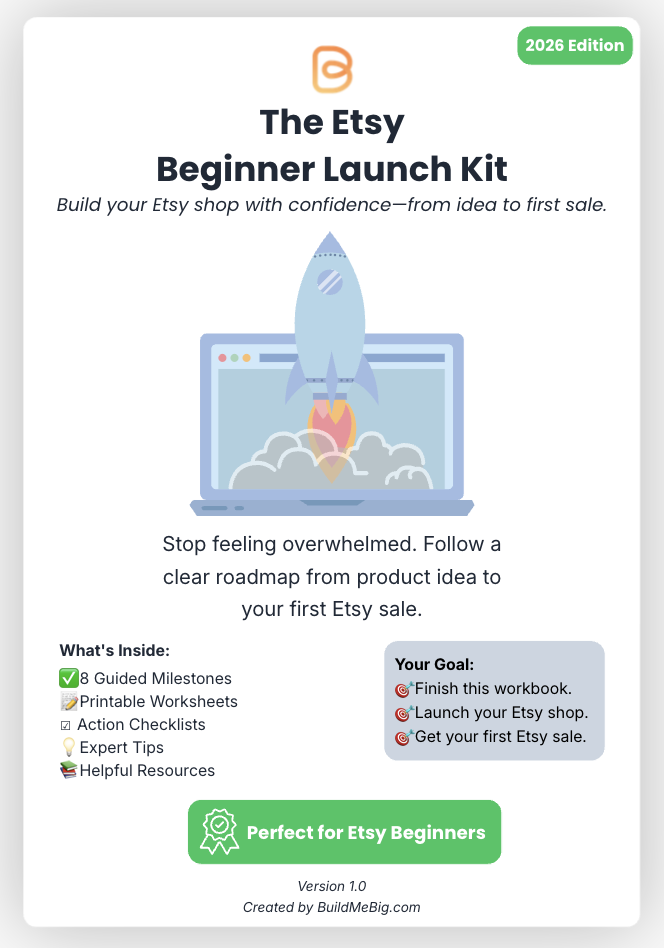
If you’re still preparing to open your Etsy shop, make sure you have the basics covered before launching. Our Etsy Beginner Launch Kit brings the essential beginner steps together in one practical PDF so you can prepare your shop with more confidence.
Designed specifically for first-time Etsy sellers who want a clear, step-by-step roadmap.
Only $9 • Instant PDF Download • Secure Checkout via Gumroad
✔ Instant Download
✔ Secure Checkout
✔ Lifetime Access
📄 PDF Format
🖨 Printable
📱 Mobile Friendly
- 20-page printable workbook
- 8 practical milestones
- Beginner friendly
- Instant digital download
FAQs About Etsy Customer Service
How quickly should I respond to Etsy messages?
Try to respond to buyer messages as promptly as reasonably possible. Etsy’s customer service standards currently include responding to at least 80% of first messages within 48 hours. Always check Etsy’s latest official guidance because platform requirements can change.
How should I respond to an angry Etsy customer?
Stay calm, check the order details and your policies, acknowledge the customer’s concern, and explain what you can do. Avoid arguing or responding emotionally.
Can Etsy sellers refuse returns?
Return requirements depend on the seller’s policies, the type of product, applicable Etsy rules, and potentially local consumer-protection requirements. Check Etsy’s current return guidance and your own shop policies before deciding how to handle a request.
How should I respond to a negative Etsy review?
Keep your response professional and brief. Avoid arguing with the buyer or pressuring them to change their review. If the feedback identifies a genuine problem, use it to improve your product, listing, or customer experience.
What should I do if an Etsy buyer opens a case?
Read the case details carefully, review the order and previous messages, gather relevant information, and respond through Etsy’s case system when required. Follow Etsy’s instructions and deadlines.
Does Etsy customer service affect search visibility?
Etsy considers customer service standards that include factors such as message response rate, on-time shipping and tracking, review rating, and case rate. Meeting Etsy’s customer service standards can help sellers avoid potential impacts on search visibility.
Should I create saved Etsy customer-service replies?
Yes. Saved responses can help you answer common questions faster while keeping your communication consistent. However, personalize them when necessary so your replies don’t feel automated or irrelevant.